
They date back to 1107 AD
CORGIS
ABOUT
Pembroke Welsh Corgis are a low-set, strong, and sturdy herding breed that originated in Wales, United Kingdom. Corgi is Welsh for “dwarf dog.” They stand 10-12” at the shoulder with females weighing 24- 28 pounds and males 24-31 pounds. They are medium sized dog with short legs. Their lifespan is 12-15 years. They have a robust appetite and will easily gain weight. Typically, feeding an adult Pembroke Welsh Corgi 1/3 to 1/2 cup of high quality dog food twice a day is sufficient for maintaining a healthy weight.
Pembroke Welsh Corgis are closely related to Schipperkes, Keeshonds, Pomeranians, Chow Chows, Norwegian Elkhounds and Finnish Spitz.
They have a thick, double, weather resistant hair coat of medium length with coat colors being red, sable, fawn, black headed tricolor, and red headed tricolor. There are often white markings on the legs, chest, neck, and parts of the muzzle. “Fluffies” have very long coats. “Bluies” have coats with a diluted color causing a bluish appearance. “Fluffies” and “Bluies” are considered breed faults. A merle coat pattern is not recognized in Pembrokes and is an indication of being crossed with another bred such as a Cardigan Welsh Corgi or an Australian Shepherd. Pembrokes ears are erect and their tails may be naturally short or docked. Their eyes are medium to dark brown. Light brown or blue eyes are considered a breed fault. The Pembroke Welsh Corgi has a “fairy saddle”, somewhat lighter markings on each side of the withers caused by changes in the thickness, length, and direction of hair growth. Pembroke Welsh Corgis are prolific shedders especially during the Spring and Summer. To control shedding, Corgis should be brushed regularly and at least every 3-5 days during Spring and Summer. I recommend using an undercoat rake for small to medium dogs or the FURminator® de-shedding tool in a size small or medium. The smaller tool is easier to handle. Anything bigger gets rather bulky brushing a Pembroke.
Pembroke Welsh Corgis are eager to please and easily trained ranking number 11 among breeds of dogs for ease of training.
They are overly sensitive to harsh or excessive discipline, but do require their owner to be authoritative. Without training and discipline the Corgi personality will be more than willing to run the home. As with all dogs, the owner must establish themselves as the ‘pack leader.’ They are very interactive with their family and very expressive. As with most dogs, socialization is important or they can be wary of strangers. Pembrokes seek the attention of everyone and are good around children and other animals. I highly recommend a fenced yard as Pembrokes will wonder off to go ‘visiting’ if they get bored. They will also seek out people for attention. They make excellent greeters wherever they find people. It is not uncommon for a Corgi to set themselves up as the greeter at the door and are more than happy to welcome themselves into the store if given a chance, or into most anyone’s vehicle. A good fenced yard will prevent frazzled nerves from worrying about a happy-go-lucky neighborhood welcoming committee wandering the town. As a herding dog, they will try to herd anything, but because they are easily trained and eager to please they will quickly learn what is acceptable and what is not. Because of their natural herding instinct, puppies will nip. This can be stopped by firmly, loudly, and consistently saying, “Ouch!”, if a toy is handy give that to the puppy. Also ignoring them for a bit will make the puppy realize that such behavior is not acceptable. A dog pen or kennel is helpful for providing a ‘time out’ space. Pembrokes can be very active as puppies, while as adults they need a minimum of 15 minutes of exercise twice a day. Pembrokes are known for “frapping,” a term that stands for “frantic running and playing,” which amounts to brief periods of exertion.
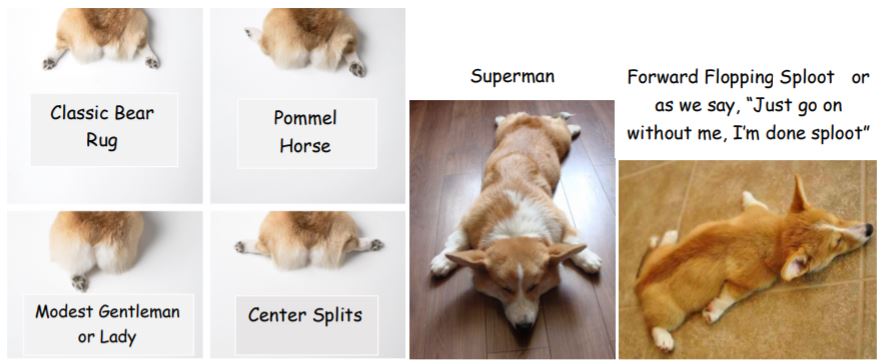
Not many breeds come with their own set of terminology, but Corgis do!
“sploot.” A Corgi sploot is where they lay on their belly with back legs stretched out behind them. Sometimes, during a sploot their front legs will be stretched out in front of them or back against their side. This is a favorite stretching, resting and sleeping position. Another term unique to Corgis is ‘rowdy.’ A group of Corgis (typically 5+) is called a rowdy and they can get pretty rowdy, especially if they all begin frapping, followed by rowdy of tired Corgis splooting. A group of Corgis can also be called a wiggle and there would be lots of wiggling going on! The “toes up” position is also unique to Corgis. This is a favorite sleeping position where they lay perfectly balanced on their backs with all four legs pointed up.

Why A Corgi?


